


Schedule Your Paint Estimate
Why Exterior Paint Fails Faster in Charleston

Paint that performs reliably in the Midwest or Pacific Northwest doesn’t face what Charleston homes face. Fifty-plus inches of rainfall a year. Summer humidity that stays above 80 percent for months at a stretch. A hurricane season that runs June through November and sends driving rain sideways into siding, trim, and any gap a previous painter left unsealed. And for homes near the water — Sullivan’s Island, Isle of Palms, the Battery, the downtown waterfront — salt air that attacks paint film from the outside while moisture pressure attacks from behind.
When prep is skipped or the wrong coating goes on the wrong surface, the result is predictable: peeling within two seasons, mildew streaks across the siding, and moisture that has already made its way into the wood substrate before anyone notices. The cost to fix a failed job almost always exceeds what it would have cost to do it right the first time.
Wade Paint Co. has spent seven years working on Charleston exteriors, and that experience starts with one principle: no coating system performs well on a surface that hasn’t been prepared properly for this climate. Before any product is selected, every project begins with an assessment of the home’s exposure — proximity to tidal water, sun orientation, surface material, and the condition of what’s already there.
Why Many New Homes Benefit From Professional Repainting
New construction paint often looks good at first glance, but appearance and durability are not always the same thing.
Many builders use production-focused painting systems designed to meet construction schedules and budgets. As homeowners settle into the space, they begin to notice scuffs that won’t clean easily, inconsistent sheen, visible drywall repairs, and finishes that show wear sooner than expected.
Professional repainting allows homeowners to:
- Upgrade builder-grade finishes
- Personalize colors throughout the home
- Improve durability and washability
- Create better flow between rooms
- Address visible drywall imperfections
- Refresh trim, doors, and millwork
- Select low-VOC products for improved indoor air quality
For many families, repainting shortly after move-in creates a home that feels more personal and performs better over the long term.

How the Weatherproofing Process Works
Every home is different, but our process remains consistent: proper preparation, premium products, and careful attention to detail.
Consultation & Climate Assessment
Every exterior project starts with an on-site evaluation, not an estimate pulled from satellite photos. Wade Paint Co. evaluates sun and wind exposure, identifies any existing paint failure, checks for moisture intrusion at trim joints and caulk lines, and determines the right coating system for the surface material and exposure level. No two Charleston properties face the same conditions — marsh-side homes have different needs than homes three blocks inland, and historic wood siding requires a different approach than HardiePlank.
Prep & Weatherproof Application
Surface preparation is where weatherproofing actually happens. Every exterior surface is pressure-washed to remove mildew, chalk, and contaminants before any product is applied. Damaged wood is repaired or replaced. Caulk lines are stripped and resealed. Substrate-specific primers are applied — alkyd-modified on bare wood for maximum adhesion, masonry primer on stucco and concrete block. Only after prep is complete does the weatherproof coating go on.
Final Walkthrough
When the project is complete, Elliott walks the property with the homeowner before closing out the job. Every coating application is backed by Wade Paint Co.’s 2-year workmanship warranty covering peeling, blistering, and chipping from defective workmanship. Questions after the project are answered directly by the owner — no service desk, no queue.
Surfaces We Paint

Wood siding

Fiber cement / HardiePlank siding

Stucco and masonry
Elastomeric coating systems that bridge hairline cracks and seal against moisture intrusion; applied over masonry-specific primer.
Exterior trim
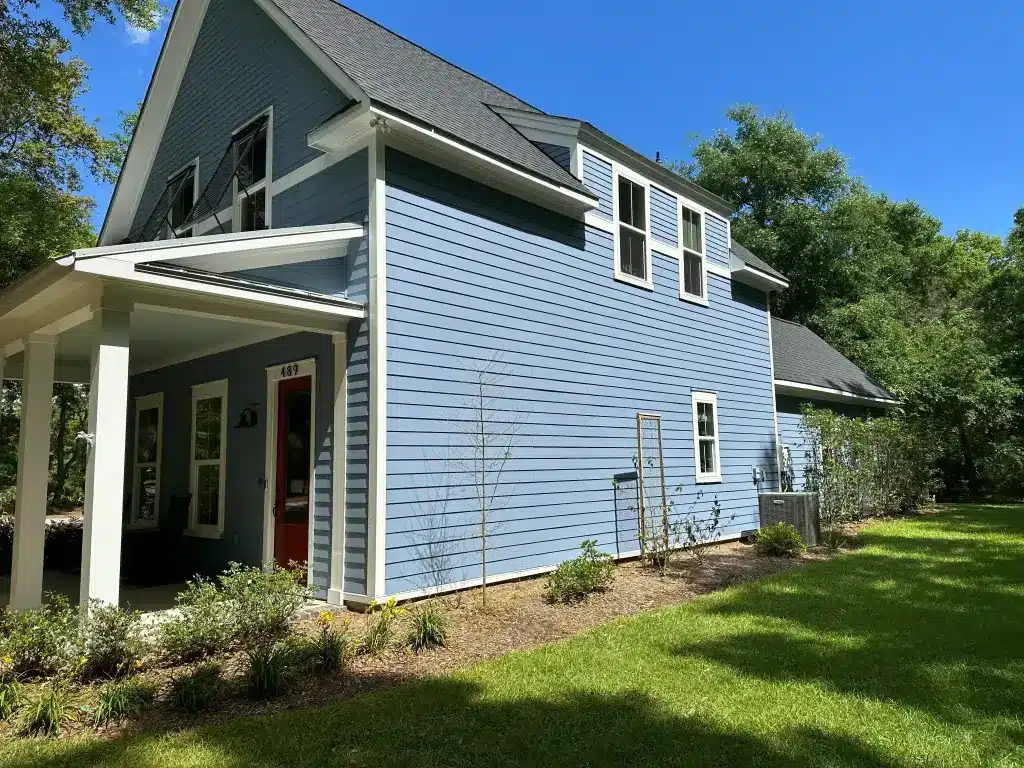
Fascia, soffits, window frames, corner boards, door frames: high-wear surfaces receive alkyd-modified or satin acrylic coatings for durability in high-UV, high-moisture conditions.

Doors and shutters
Premium acrylic or alkyd-modified finishes in the appropriate sheen for lasting color and durability.
Decks and fences
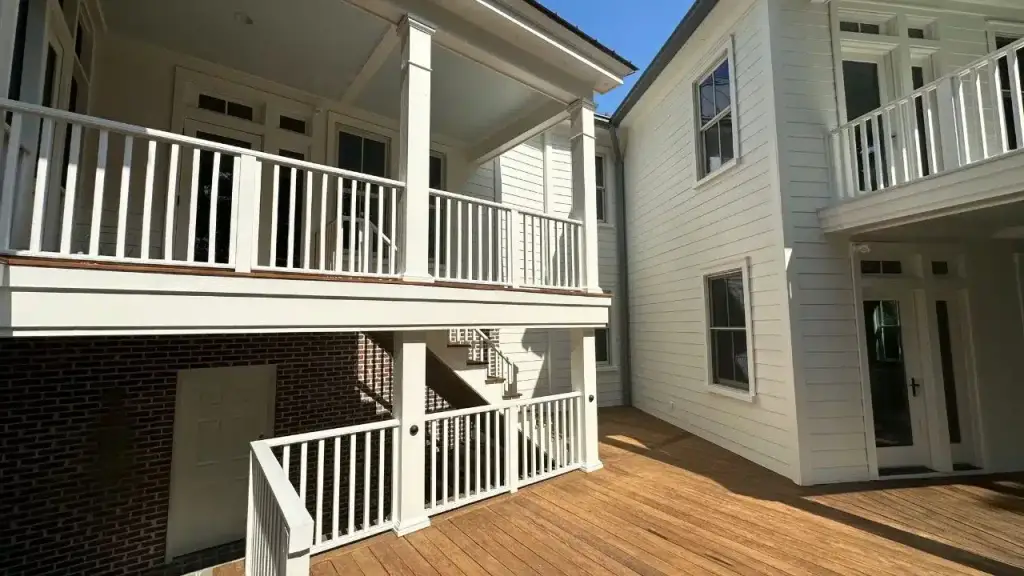
wood staining and sealant systems available — see the deck and fence painting page for full service detail
Coating Selection: The Right Product for Each Surface
One of the most common mistakes in exterior painting is using a one-size product on every surface. What performs well on wood siding fails on masonry. What works for trim needs a different primer than what works for fiber cement. Wade selects coating systems by surface material and exposure level.
Wood siding and trim
Premium 100% acrylic latex is the standard for painted wood surfaces in Charleston. Acrylic is moisture-vapor permeable — it allows the wood substrate to breathe rather than trapping moisture behind the paint film, which is critical in a climate where humidity levels swing dramatically between seasons. For bare or weathered wood, an alkyd-modified primer provides the adhesion foundation the topcoat needs.
Masonry and stucco
Elastomeric coatings are the correct system for unpainted or repainted stucco and concrete masonry. Elastomeric products stretch and compress with temperature-driven movement in masonry substrates, bridging hairline cracks rather than cracking with them. For homes with existing elastomeric, subsequent coats must be compatible — mixing systems causes adhesion failure. See the full treatment in the elastomeric coatings guide.
Fiber cement / HardiePlank
Products Wade Paint Co. applies
- Sherwin-Williams Duration Exterior — self-priming option, built-in mildewcide, proven UV stability.
- Sherwin-Williams Emerald Exterior — top-tier moisture-vapor permeable formula; superior stain resistance; color retention in high-sun environments.
- Benjamin Moore Aura Exterior — Color Lock technology; fade-resistant formulation; excellent performance in high-humidity climates.
No bargain-brand substitutions. Every product selected is appropriate for the surface and the Lowcountry climate.
Historic District & Permit Considerations
Exterior painting and coating work in Charleston’s historic district may require approval from the Board of Architectural Review (BAR) before work begins. This applies to changes in color, material, or coating type on structures within the BAR jurisdiction. Wade Paint Co. handles permit coordination for applicable scopes — homeowners don’t need to navigate the BAR process alone.
For homes with existing lead paint (common in pre-1978 structures, particularly in the historic district), EPA RRP (Renovation, Repair, and Painting) protocols apply to any project that disturbs lead-containing surfaces. Wade’s process accounts for these requirements.
Reviews from our Customers
Historic District & Permit Considerations
Exterior painting and coating work in Charleston’s historic district may require approval from the Board of Architectural Review (BAR) before work begins. This applies to changes in color, material, or coating type on structures within the BAR jurisdiction. Wade Paint Co. handles permit coordination for applicable scopes — homeowners don’t need to navigate the BAR process alone.
For homes with existing lead paint (common in pre-1978 structures, particularly in the historic district), EPA RRP (Renovation, Repair, and Painting) protocols apply to any project that disturbs lead-containing surfaces. Wade’s process accounts for these requirements.

Why Charleston Landlords Choose Wade Paint Co.
Rental property owners need more than a painter. They need a contractor who understands scheduling, durability, and long-term property maintenance.
84+ five-star Google reviews from Charleston-area homeowners
Owner oversight from Elliott Hall throughout the project
Written estimates with clearly defined scope and timelines
Sherwin-Williams and Benjamin Moore premium products
A 2-year workmanship warranty
Licensed, bonded, and insured service
Charleston's Best Finalist recognition in 2022 and 2023
EPA RRP compliance for pre-1978 homes
Areas We Serve
- Charleston: Downtown Charleston, South of Broad, Wagener Terrace, and surrounding historic neighborhoods.
- West Ashley: From established neighborhoods along Highway 61 to newer residential communities.
- Mount Pleasant: Including Snee Farm, I’On, Hamlin Plantation, and surrounding neighborhoods.
- James Island: Homes exposed to coastal humidity and salt-air conditions.
- Daniel Island: Including projects that require HOA or Architectural Review Board approval for exterior color changes.
- Sullivan’s Island and Isle of Palms: Coastal homes where substrate preparation and premium primers are particularly important.
- North Charleston: Serving homeowners across a wide range of property ages and architectural styles.
- Johns Island and Folly Beach: Supporting homeowners preparing properties for resale in two of the region’s fastest-growing markets.
Get Your Free Weatherproofing Estimate
Charleston's exterior conditions don't get easier to manage. The right coating system — applied to a properly prepared surface — is the only thing that holds up long-term.
Frequently Asked Questions
What causes exterior paint to peel quickly in Charleston?
The most common causes are skipped or inadequate surface preparation and product selection that isn’t suited to coastal conditions. In Charleston’s climate, moisture is the primary driver of paint failure — it can enter through unsealed caulk lines, uncaulked trim joints, and bare wood that wasn’t primed before topcoating. When moisture gets behind the paint film, it pushes the coating off the substrate. Mildew growth underneath the paint accelerates that process. The fix is thorough prep: pressure washing, rot repair, sealing, priming — before any topcoat goes on.
How long does weatherproof exterior paint last in the Lowcountry?
Does Wade Paint Co. use elastomeric coatings on stucco homes?
Should I repaint the exterior before hurricane season?
What's the difference between weatherproof paint and regular exterior paint?
“Weatherproof paint” isn’t a single product category — it describes any exterior coating system properly matched to the surface material and climate conditions it will face. Premium acrylic latex formulations from brands like Sherwin-Williams and Benjamin Moore include mildewcide additives, UV-stable pigments, and moisture-vapor permeability that standard exterior products may not. The real distinction is in prep and product selection together — the best weatherproof paint still fails on a surface that wasn’t properly prepared.
How do you prep a house for weatherproof painting?
Wade Paint Co.’s exterior prep process includes: pressure washing all surfaces to remove mildew, chalk, and contaminants; repairing or replacing damaged or rotted wood; stripping and reapplying caulk at all trim joints, window frames, and penetrations; sanding where needed to create a proper surface for primer adhesion; applying substrate-specific primer (alkyd-modified for bare wood; masonry primer for stucco and concrete block); and inspecting for moisture intrusion before any topcoat is applied. Prep is the foundation that makes the coating last.
Is exterior painting in Charleston's historic district regulated?
Yes. Properties within the jurisdiction of Charleston’s Board of Architectural Review (BAR) may require design review approval before exterior color or material changes are made. This includes repaints in new colors and certain coating changes on historic structures. Wade Paint Co. is familiar with the BAR process and coordinates permits for applicable projects. Contact us to discuss your specific property.
What's the minimum temperature for exterior painting in Charleston?
The safe application window for most exterior acrylic and elastomeric products is between 50 and 85 degrees Fahrenheit, with humidity below 85 percent. Below 50°F, acrylic latex paints don’t cure properly and adhesion is compromised. Charleston’s winters are mild enough that exterior painting is typically possible year-round, though the December–February period requires monitoring overnight temperatures to ensure they stay above 35°F after application. Wade schedules around Charleston’s weather patterns to get the application window right.