


Home / Services / Interior Painting / Kitchen
Kitchen Painting in Charleston, SC
Walls, Cabinets & Trim Built to Handle the Lowcountry
Enjoy A Home that Feels Like Home
Licensed, Bonded, and Insured
84+ Five-Star Reviews
Charleston’s Best Finalist (2022, 2023)
2-Year Workmanship Warranty
Certified Painting Contractors


Why Kitchen Paint Fails in the Lowcountry and What Proper Prep Looks Like
Charleston's year-round subtropical climate means your kitchen runs hotter, longer, and wetter than kitchens in drier inland markets. Cooking steam, grease vapor, and salt air create a surface environment that rejects cheap primer and flat paint within months, not years. A properly prepped kitchen painting project is designed to solve that.
1. Painted Cabinets Last 8–12 Years Without Replacement Cost
Properly degreased and primed cabinet faces — HVLP-sprayed with Sherwin-Williams Emerald or Benjamin Moore Aura — hold their finish for 8–12 years under normal kitchen use. Kitchen cabinet replacement in the Charleston market starts at $15,000; a complete professional cabinet repaint is a fraction of that cost with the same visual result.
2. Stain-Blocked Ceilings Stop the Yellow Before It Returns
Kitchen ceilings above the range absorb aerosolized grease all year in a Lowcountry home. An oil-based stain-blocking primer — Sherwin-Williams Extreme Block or Zinsser BIN shellac primer — seals the grease layer before the finish coat goes on. Skip this step, and the new ceiling paint begins yellowing within 12–18 months regardless of how good the topcoat is.
3. A Fresh Kitchen Is the First Thing Buyers Notice
Freshly painted cabinets and updated wall color signal a maintained home to buyers in Charleston’s active market — and that signal carries weight far beyond the sticker price on a repaint project.
4. Semi-Gloss Walls Clean Up in Seconds
Satin and semi-gloss finishes are wiped clean with a damp cloth. Flat paint — still original in many West Ashley and James Island kitchens from the 1970s and 80s — cannot be scrubbed without removing the paint film. The sheen upgrade alone extends the life of a kitchen repaint by several years.
5. Low-VOC Paints — Kitchen Usable Within 24–48 Hours
Sherwin-Williams Emerald Interior and Benjamin Moore Aura Interior are GREENGUARD Gold certified. We schedule application around Charleston’s morning humidity windows so dry times are not extended by afternoon coastal air.
Charleston Kitchen Painting Styles: From Avondale Ranch to Daniel Island Open Plan
Charleston kitchens span nearly a century of construction — from compact 1950s galley kitchens in Riverland Terrace to the wide, island-centered open-plan spaces in Daniel Island’s newer neighborhoods — and the painting approach shifts with the space, the wall material, and how the kitchen connects to the rest of the home.
| Style | Description | Local Context | Neighborhood Note |
|---|---|---|---|
| Two-Tone Contrast | Light uppers / dark lowers (navy, sage, charcoal) | Popular in Mt Pleasant's I'On & Park West — open-concept layouts visible from street | Some I'On & Park West HOAs require palette review for exterior-visible colors |
| Full White/Off-White Refresh | All cabinets in SW Alabaster, BM Chantilly Lace, or similar | Strongest resale choice in West Ashley & James Island buyer market | Avondale & Riverland Terrace pre-1970 kitchens — oil-based stain primer mandatory for bleed-through |
| Deep & Saturated | All-over navy, dark green, or charcoal | Suits tall-ceilinged historic kitchens South of Broad & Harleston Village | Ansonborough / French Quarter plaster walls require PVA primer before any latex |
| Color-Blocked Island | Neutral perimeter; accent island | Common in Daniel Island homes where large islands anchor open-plan layouts | Islands need 3 finish coats for even, deep coverage — budget 15–20% more time |
| Natural Wood + Painted Perimeter | Select cabinets left in wood/stain; perimeter painted | Farmhouse aesthetic on Sullivan's Island & Isle of Palms beach homes | Coastal properties need high-humidity adhesion primer — standard primer fails within 18 months |
| Walls & Ceiling Only | Walls and ceiling refreshed; cabinets unchanged | Budget-friendly in John's Island homes with newer cabinetry | Range-adjacent walls need TSP degreasing — grease film is invisible until it rejects new paint |
Other kitchen painting work we handle:
- Cabinet door refresh only (doors repainted; box frames left as-is)
- Backsplash-adjacent wall sealing and repaint
- Grease-saturated ceiling stain block and repaint
- Crown molding and trim refresh
- Window casing and sill repainting in sun-exposed kitchens
- Kitchen island accent painting
Lowcountry Kitchens Have a Grease Problem Most Painters Don't Plan For
Charleston’s mild winters mean range hoods are running 12 months a year and that adds up to more grease vapor on kitchen walls and ceilings than you’d see in a kitchen in Ohio or Denver in the same period. Elliott and Kaylee Hall have seen enough Lowcountry kitchens to recognize, on first walkthrough, which walls need an oil-based stain primer before any latex finish coat has a chance of sticking and which ones can be degreased and primed conventionally. That read is what saves clients from a failed paint job six months later.
Why Humidity-Resistant Primers and Semi-Gloss Sheens Are Non-Negotiable in the Lowcountry
Charleston’s outdoor humidity runs 70–75% year-round, climbing above 80% in summer and your kitchen adds another layer on top of that: boiling water, dishwasher exhaust, steaming vegetables, and cooking oils that aerosolize at cooking temperature. In that environment, primer selection is the difference between a paint job that holds for a decade and one that peels by the following summer.
| Finish | Best For | Pros | Cons |
|---|---|---|---|
| Semi-Gloss (cabinets & backsplash walls) | Cabinet faces, doors, backsplash-adjacent walls | Highest moisture resistance; scrubbable after 30-day cure; reflects light to brighten smaller kitchens | Amplifies surface imperfections; requires fine sanding between coats and HVLP spray to avoid brush-mark telegraphing |
| Satin (kitchen walls) | All four kitchen walls; island perimeter | Washable; more forgiving on textured surfaces; suited for humid rooms per SW/BM specs | Less moisture-resistant than semi-gloss; shows burnishing if scrubbed hard in first 30 days |
| Eggshell (not recommended) | Low-humidity rooms only | Hides wall texture better than satin | Cannot be scrubbed; grease stains permanent; needs full repaint within 2–3 years in active Charleston kitchen |
| Flat / Matte (never in kitchens) | Bedrooms, hallways | Excellent at hiding imperfections in low-traffic spaces | Absorbs grease; paint film degrades within 12–18 months in Lowcountry kitchen conditions |
The choice of sheen matters as much as the choice of brand. A premium paint applied in the wrong sheen on a kitchen surface is a failed paint job waiting to happen — which is why finish selection is part of the estimate conversation, not an afterthought at the hardware store.
Kitchen Cabinet Painting vs. Refacing vs. Replacement: An Honest Comparison
This is the question most Charleston homeowners are actually asking when they call about cabinet painting.
| ✔ Pros | ✖ Cons |
|---|---|
| Cost of a full cabinet repaint runs approximately $1,800–$3,500 vs. $15,000–$40,000+ for new cabinetry | Paint life is 8–12 years under normal use. Cabinets in active family kitchens can show wear at door edges and around pulls within 3–5 years without a hardener additive |
| HVLP spray produces a factory-smooth finish indistinguishable from new cabinetry when done correctly | The prep is the entire job: any painter who skips degreasing or uses the wrong primer produces a finish that chips within 12 months — making the cabinets look worse than before |
| Color is fully customizable — not limited to box-store inventory | A dramatic color change (dark navy to bright white) requires an additional barrier primer coat and at least 3 finish coats — adds cost and an extra half-day of work |
| Low-VOC options allow kitchen use within 24–48 hours of final coat | Cabinet interiors (box shelves and liner surfaces) are not painted in a standard repaint — exterior faces and doors only. Worn interiors may require full replacement for a satisfying result |

How Cabinet Painting Compares to Alternatives
Cabinet refacing ($4,000–$9,000 nationally): Replaces doors and drawer fronts only; box frames stay original. Better structural outcome if frames are sound but visually dated. Cabinet painting produces a similar visual result at lower cost when the box frames are in good condition. If frames are warped, swollen, or have delaminating veneer, refacing or replacing is the right call.
Full cabinet replacement ($15,000–$40,000+ in Charleston market): The right choice when boxes are structurally unsound, the layout no longer works, or significant water damage has occurred. In West Ashley homes built in the 1960s and early 1970s, cabinet box frames sometimes have moisture damage that painting will not resolve.
Warranty: What Is and Is Not Covered
Wade Paint Co.’s 2-year workmanship warranty covers: paint adhesion failure, finish coat delamination, visible brush marks or drips in the final coat.
It does not cover: normal edge wear at high-contact surfaces (pulls/knobs), damage from bleach or abrasive cleaners, or water damage from plumbing events or flooding.
Kitchen Painting Projects in Charleston, SC
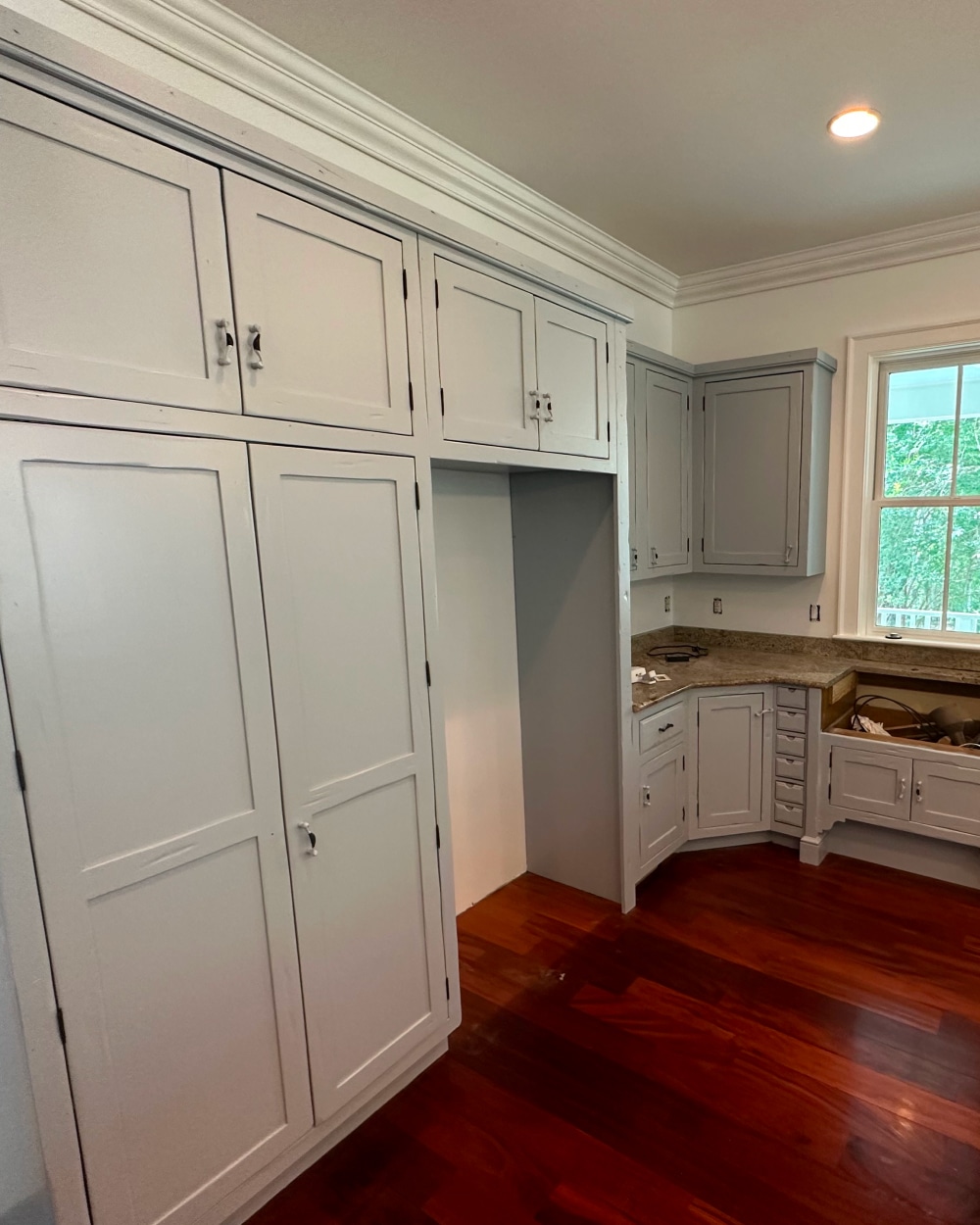
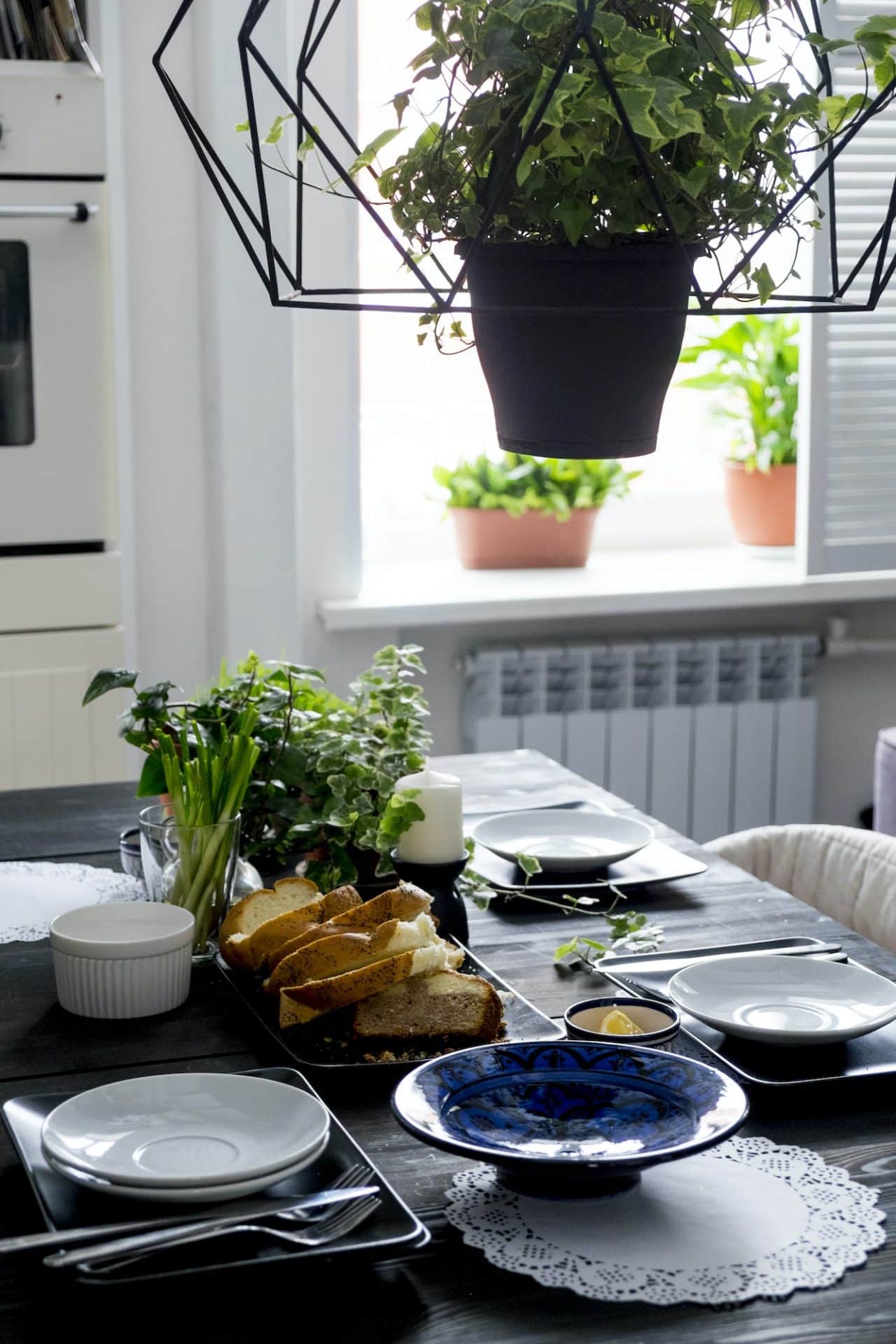
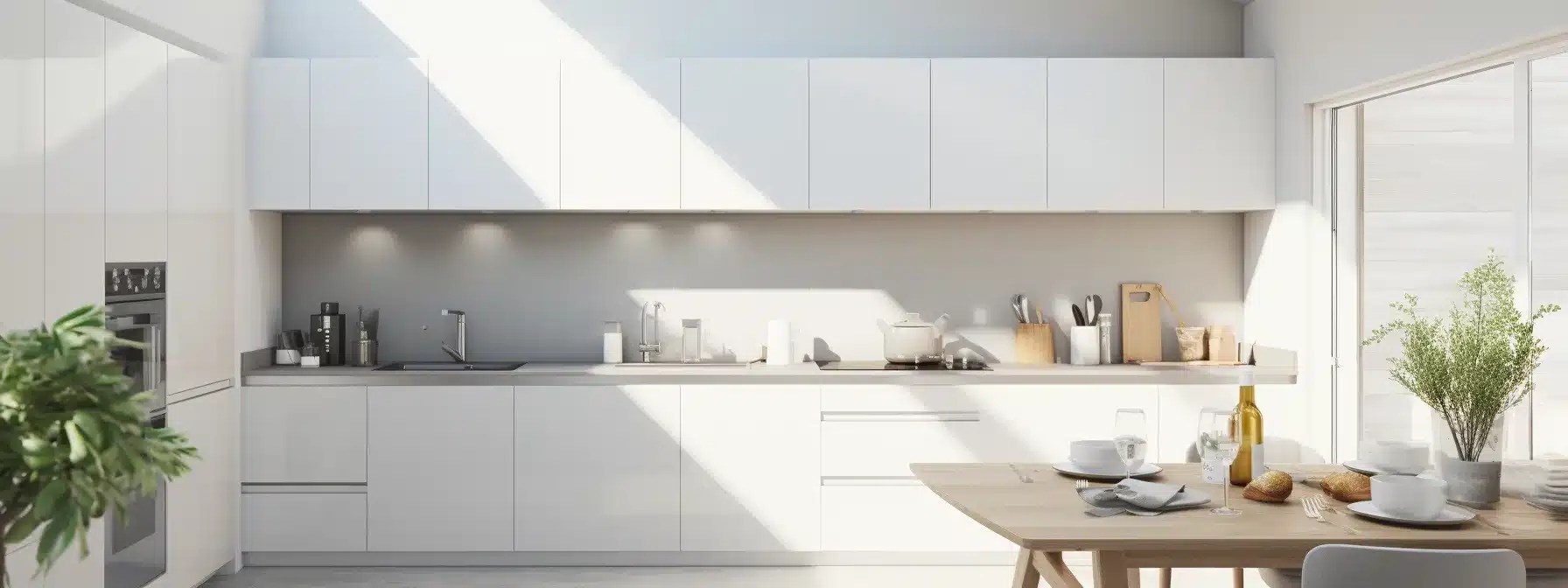
How Wade Paint Co. Handles Kitchen Painting in Charleston
Kitchen painting is prep work that happens to end with a brush. The finish coat is 20% of the job — the other 80% is what determines whether the paint is still on the wall in five years.
Degreasing comes before anything else.
In a Charleston kitchen that’s been actively cooked in for several years, walls and ceiling surfaces absorb an invisible film of aerosolized grease — particularly in the 36-inch band of wall above the range. This film is inert to latex paint. Surfaces are washed with a commercial degreaser before any primer contacts the substrate, and the range-adjacent ceiling gets a separate inspection to determine whether a standard PVA primer will hold or whether an oil-based stain blocker (Sherwin-Williams Extreme Block or Zinsser BIN) is required.
Cabinet doors come off; HVLP spray goes on.
Cabinet doors and drawer fronts are removed, cleaned, sanded to 220-grit, and primed before the finish coat. We use HVLP spray equipment — not a brush or roller — for all cabinet surfaces. The result is a factory-smooth finish with no brush marks, no drips, and no texture inconsistencies.
We check humidity before we spray finish coats.
Charleston’s summer afternoons frequently push outdoor relative humidity above 80%. Applying a latex finish coat above 85% RH produces adhesion problems that are invisible at first and catastrophic by month six. Before any finish coat goes on, we check ambient conditions with a hygrometer.
Expert Save — West Ashley, Avondale
On a 1964 ranch kitchen in Avondale, the first primer coat immediately revealed “alligatoring” — a reptile-scale pattern forming as new latex paint contracted against the original oil-based alkyd paint beneath. The incompatibility was invisible before the primer went on. We stopped, applied a full barrier coat of oil-based primer to neutralize the substrate, and relaunched the finish coat sequence the following day.
A painter who doesn’t recognize alligatoring proceeds. The kitchen peels within a year.
Cost of Kitchen Painting in Charleston, SC
“How much does kitchen painting cost?”. The honest answer depends on what exactly is being painted and how much prep the surfaces actually need.
| Service | Price Range | Details |
|---|---|---|
| Wall & Ceiling Only (cabinets not included) | $400–$900 | Depends on ceiling height, wall condition, stain-blocking primer requirements. |
| Full Cabinet Repaint (exterior faces, doors, drawer fronts) | $1,800–$3,500 for avg 20-linear-foot kitchen | Degreasing + bonding primer + 2 finish HVLP coats. |
| Complete Kitchen Refresh (walls + ceiling + cabinets) | $2,200–$4,500 for average Charleston kitchen | Most impactful single-room project without touching structure, plumbing, or electrical. |
What Moves the Price
- Ceiling Height: Every foot above 9 feet adds labor cost. Scaffolding setup in a narrow historic Charleston hall adds 30–90 minutes beyond an open room
- Plaster Wall Condition: Active cracking requires proper stabilization. This determines whether the paint holds for 5 years or 6 months
- Water Staining: Each stain requiring oil-based primer adds material cost and a drying day before the finish coat schedule can begin
- Trim Complexity: Crisp cut-in at crown molding in a room with 12-ft ceilings is a full day of brushwork. Minimal trim rooms are faster
- Color Change Severity: Dark-to-light or light-to-dark requires an additional primer coat and often three finish coats instead of two
- Scope Continuity: An open-plan living/dining/staircase is priced as one continuous scope — treating it as three separate rooms produces mismatched sheen and coverage

Maintaining Your Kitchen Paint in Charleston's Climate
Post-summer ceiling inspection (Charleston-specific)
After August and September — Charleston’s most humidity-intensive months — inspect your kitchen ceiling above the range for early signs of paint softening, bubbling, or chalking. Catching adhesion issues in year two is far cheaper than a full ceiling repaint in year three.
Cleaning painted cabinets in the Lowcountry
Use a barely-damp microfiber cloth and mild dish soap. Avoid any cleaner containing bleach, ammonia, or abrasives — these degrade the paint film faster in Charleston’s warm climate. The 30-day cure window is critical: do not aggressively clean new cabinet paint for the first 30 days after application.
Monitoring the backsplash junction
The caulk seal between the painted wall and tile backsplash is the most vulnerable point in a Charleston kitchen. Seasonal humidity cycles cause paintable caulk to crack — once the seal opens, moisture wicks under the paint edge. Inspect this joint annually; re-caulk when hairline cracks appear.
Year-3 cabinet edge touch-up
Cabinet edges around pulls and knobs show wear before any other part of the cabinet. At year 3–4, apply spot touch-up using the same paint line and sheen — keep a labeled pint for this purpose. Touch-up at the right time extends the full-repaint cycle by 3–5 years.
Range hood filter maintenance
A range hood filter cleaned every 2–3 months prevents grease-laden air from circulating and depositing on kitchen walls and ceiling. Particularly relevant in compact peninsula kitchens and the smaller galley kitchens common in Avondale and Riverland Terrace where range hoods sometimes recirculate rather than exhaust to exterior.
Kitchen Painters in Charleston, SC and Surrounding Communities
| Area | Details |
|---|---|
| Charleston Peninsula | Historic homes South of Broad, French Quarter, Harleston Village, and Ansonborough. Plaster wall prep expertise; kitchen ceilings commonly reach 10–12 ft, requiring ladder work. |
| Mount Pleasant | I'On, Old Village, Park West, and Rivertowne — full range from cottage-scale kitchens to large open-plan builds with extensive trim. |
| West Ashley | Avondale's 1940s–1960s ranch kitchens (stain-blocking primer standard); Shadowmoss 1980s builds (more conventional); Riverland Terrace bungalows with original plaster ceilings. |
| Daniel Island | Newer, larger homes with open-plan kitchens; projects frequently extend to adjacent dining areas. |
| James Island | Compact mid-century kitchens in Harborview and Riverland Terrace; frequent ceiling remediation needs. |
| Sullivan's Island | Coastal exposure demands moisture-rated primers; salt air ingress via kitchen exhaust is an active challenge. |
| Isle of Palms | Similar coastal prep requirements to Sullivan's Island; beach cottage kitchens frequently need full ceiling remediation. |
| John's Island | Growing residential mix; both new-construction touch-up and full repaints in older farmhouse-era homes. |
Related Painting Services from Wade Paint Co.

Deck & Fence Staining


Frequently Asked Questions
How much does kitchen painting cost in Charleston, SC?
A full kitchen cabinet repaint typically runs $1,800–$3,500 for an average 20-linear-foot kitchen in Charleston, Mount Pleasant, or West Ashley for precise current pricing. Wall and ceiling painting adds $400–$900 depending on ceiling height and surface condition. A complete kitchen refresh runs $2,200–$4,500. We provide a written estimate before any work begins — no surprises.
How long does kitchen painting take?
A typical kitchen paint project runs 2–4 days for an average Charleston kitchen. Large open-plan kitchens in Daniel Island or Mount Pleasant that include adjacent dining areas may take 4–5 days. Cabinet doors are sprayed, dried, and hung on the final day. Your kitchen is accessible for most of the project.
Do I need a permit to paint my kitchen in Charleston?
Interior cosmetic painting — including walls, ceilings, and cabinets — does not require a building permit in Charleston, SC for standard residential properties. The process by the Board of Architectural Review (BAR) applies only to exterior painting color changes on historic-district properties. Interior kitchen painting is not subject to BAR review.
What paint is best for kitchens in Charleston's climate?
Satin or semi-gloss sheens are the correct choice — both are washable and moisture-resistant. We use Sherwin-Williams Emerald Interior on walls (low-VOC, rated for high-humidity environments) and Sherwin-Williams Duration Home or Benjamin Moore Cabinet Coat on cabinet faces and doors (alkyd-fortified, bonds without sanding to bare wood). Primer selection — bonding primer for cabinets, oil-based stain-blocking primer for grease-contaminated ceilings — matters as much as the finish coat.
How long does kitchen paint last in the Lowcountry?
Wall and ceiling paint, properly primed in satin or semi-gloss, typically lasts 5–8 years in an active Charleston kitchen. Cabinet paint, degreased, primed, and HVLP-sprayed in semi-gloss, typically lasts 8–12 years. Charleston’s high year-round humidity puts more stress on kitchen paint than drier markets — which is why proper prep is the only variable that actually controls longevity.
What does Wade Paint Co.'s warranty cover on kitchen painting?
Our 2-year workmanship warranty covers defects in workmanship — including paint adhesion failure, finish coat bleed-through, and visible brush marks or drips in the final coat. It does not cover normal wear at high-contact surfaces (cabinet edges around pulls/knobs), damage from bleach or abrasive cleaners, or water damage from plumbing events or flooding.
Ready to Stop Looking at That Yellowed Kitchen Ceiling?
From West Ashley ranch kitchens to the tall-ceilinged historic homes South of Broad, every kitchen in the Lowcountry deserves prep designed for what it actually goes through — not what a national franchise's standard spec sheet assumes.