


Schedule Your Paint Estimate

Why Charleston Homeowners Choose Wade Paint Co. for Cabinet Refinishing
Kitchen cabinets are the biggest visual element in the room, and the most expensive to replace. A tear-out and full replacement in a Mount Pleasant or Daniel Island kitchen quickly runs into five figures. Refinishing gives you a factory-smooth finish, a modern color, and cabinets that look brand-new for a fraction of that cost.
Most cabinet paint failures come down to prep. Grease was never removed, the wrong primer was used, or doors were rehung before the coating had cured. By the time peeling, chipping, or blocking shows up, the repair often costs more than doing the job correctly the first time.
Wade Paint Co. has been refinishing cabinets in Charleston since 2019. Elliott is on every job — from the substrate inspection during the estimate to the final walkthrough before the doors are rehung.
How Your Cabinets Get Refinished —
Our 3-Step Process
On-Site Consultation and Color Planning
Elliott walks your kitchen, checks the cabinet substrate, and reviews color direction with you.
We determine whether you have solid wood, MDF, laminate, or a combination because the substrate determines which primer we use. We also look at lighting, hardware options, and how the color will read throughout the day.
Degreasing, Sanding, and Priming
This is where most cabinet paint jobs are won or lost.
Every surface is cleaned with TSP or a professional cabinet degreaser to remove the cooking grease film that builds up over time. We then scuff-sand all faces and edges to 220 grit, repair dents, fill damage, and caulk gaps.
Primer selection depends on the substrate. Solid wood receives a bonding primer. Laminate, thermofoil, and factory-lacquered surfaces receive Zinsser BIN shellac-based primer, which is designed to bond to slick surfaces where standard primers fail.
Cure Time, Reassembly, and Final Walkthrough
We wait at least 7 days before rehanging doors, and 10 days minimum during Charleston’s humid summer months.
Cabinet coatings may feel dry within hours, but they continue curing for 14–30 days. Waiting reduces the risk of blocking, where painted surfaces fuse together when they touch.
Why Rental Properties Require a Different Painting Approach
For most Charleston homeowners, refinishing is the right choice when the cabinet boxes are structurally sound, and the goal is an updated look rather than a new layout.

Cabinet Refinishing
- A fraction of the replacement cost
- Typically 7–10 days
- Partial kitchen downtime
- Keeps the existing layout
- Best for solid, structurally sound cabinets

Cabinet Replacement
- Full remodel budget
- Often 4–8 weeks
- Full kitchen tear-out
- Allows layout changes
- Best for damaged boxes or major remodels
The Products We Use
We use two primary cabinet topcoats and select between them based on door style, color, and expected wear. Both products are designed for cabinets and trim, not walls. Primer selection again depends on substrate, with Zinsser BIN shellac-based primer used on laminate, thermofoil, and factory-lacquered surfaces.
Benjamin Moore Advance
Most residential kitchens
Waterborne alkyd hybrid that self-levels into a smooth finish and hardens like a traditional enamel.
Sherwin-Williams Emerald Urethane Trim Enamel
Heavy-use kitchens
Alkyd-modified acrylic with a polyurethane crosslinker that cures harder than standard acrylic.
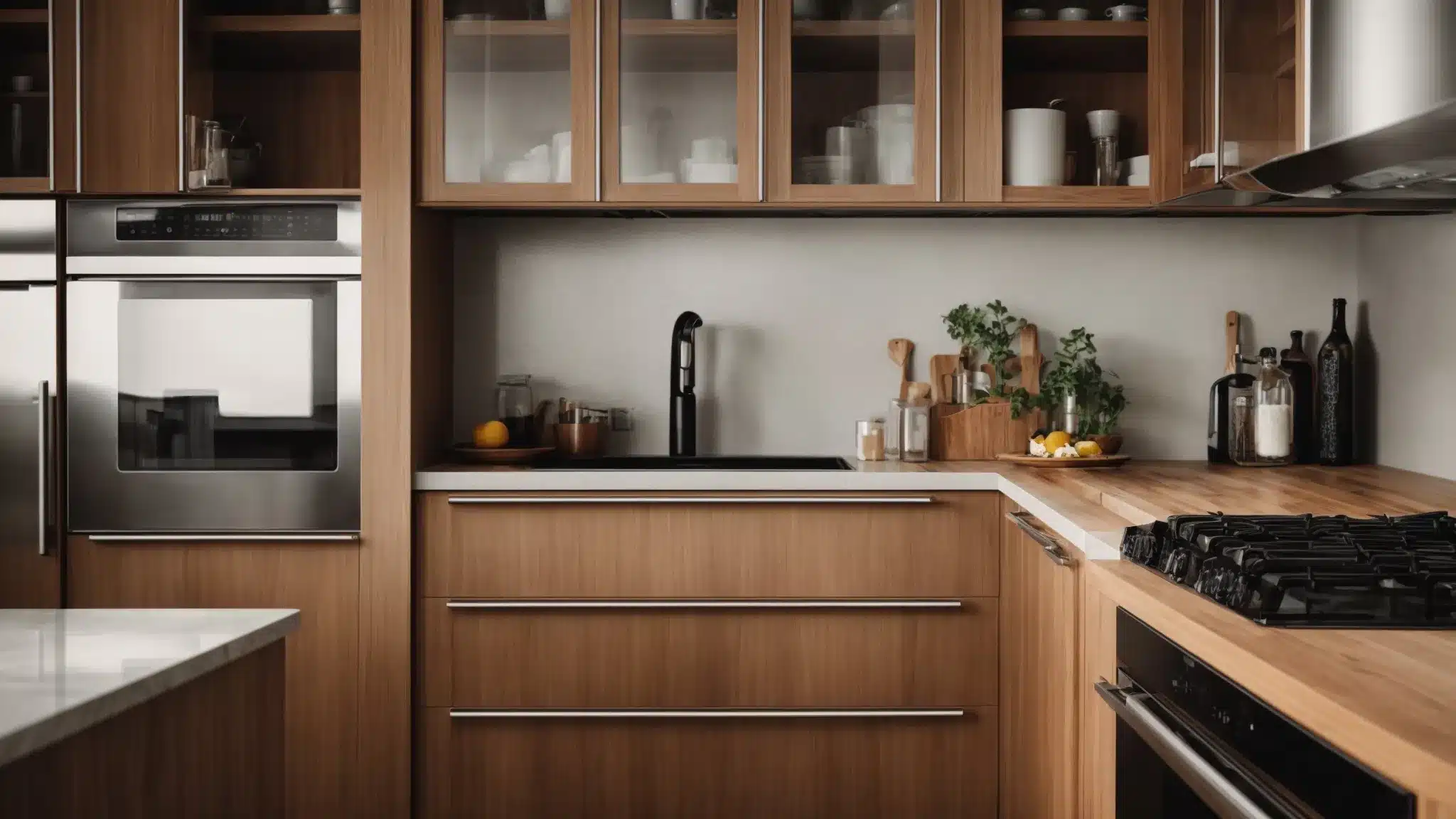
Why a Factory-Smooth Spray Finish Matters
A brushed cabinet door shows brush strokes. A rolled door shows stipple. Under kitchen lighting, that texture becomes visible every day.
A sprayed door is smooth — no brush marks, no stipple, and no roller texture.
That smooth film reflects light evenly and produces the same finish used on factory-built cabinets. For that reason, we spray cabinet doors rather than brush-and-roll them.
Popular Cabinet Colors for
Lowcountry Homes
- Benjamin Moore White Dove (OC-17) — warm white that works with most countertops and flooring.
- Sherwin-Williams Alabaster (SW 7008) — slightly creamier white popular in traditional kitchens.
- Benjamin Moore Chelsea Gray (HC-168) — warm mid-tone gray often paired with white perimeter cabinets.
- Sherwin-Williams Naval (SW 6244) — deep navy frequently used on islands and lower cabinets.
- Sherwin-Williams Evergreen Fog (SW 9130) — muted green that reads coastal without being overly bold.
Every cabinet project includes a color consultation so you can see samples in your kitchen through a full day of lighting before making a final decision.
Lead Paint Considerations for Charleston's Pre-1978 Homes
If your home was built before 1978, older layers of paint may contain lead, even if newer coatings applied over the years do not.
When painted surfaces are scraped, sanded, or otherwise disturbed, homeowners should ask their contractor what lead-safe work practices will be used to contain dust and debris and how cleanup will be handled during the project.
For more information about lead paint in older homes and the federal Renovation, Repair and Painting (RRP) requirements, visit the EPA’s Lead Renovation, Repair and Painting Program.
Refinishing Cabinets in Charleston's Coastal Climate
Charleston’s humidity affects cabinet coatings in two ways: it extends cure time, and it influences product selection.
Waterborne alkyd products cure by evaporation and oxidation, both of which slow down in high humidity. A 14-day cure in a drier climate can stretch closer to 30 days during a Charleston summer, which is why we wait longer before rehanging doors.
We also stick to products that have performed well in coastal Southeast kitchens — Benjamin Moore Advance and Sherwin-Williams Emerald Urethane Trim Enamel — because they have proven reliable in Charleston’s heat and humidity.

Charleston-Area Neighborhoods
We Serve
We refinish cabinets throughout the Charleston metro, including:
- Mount Pleasant — I’On, Old Village, and developments off Rifle Range Road
- Daniel Island
- Downtown Charleston — including many pre-1978 homes
- West Ashley
- James Island and Johns Island
- Sullivan’s Island and Isle of Palms
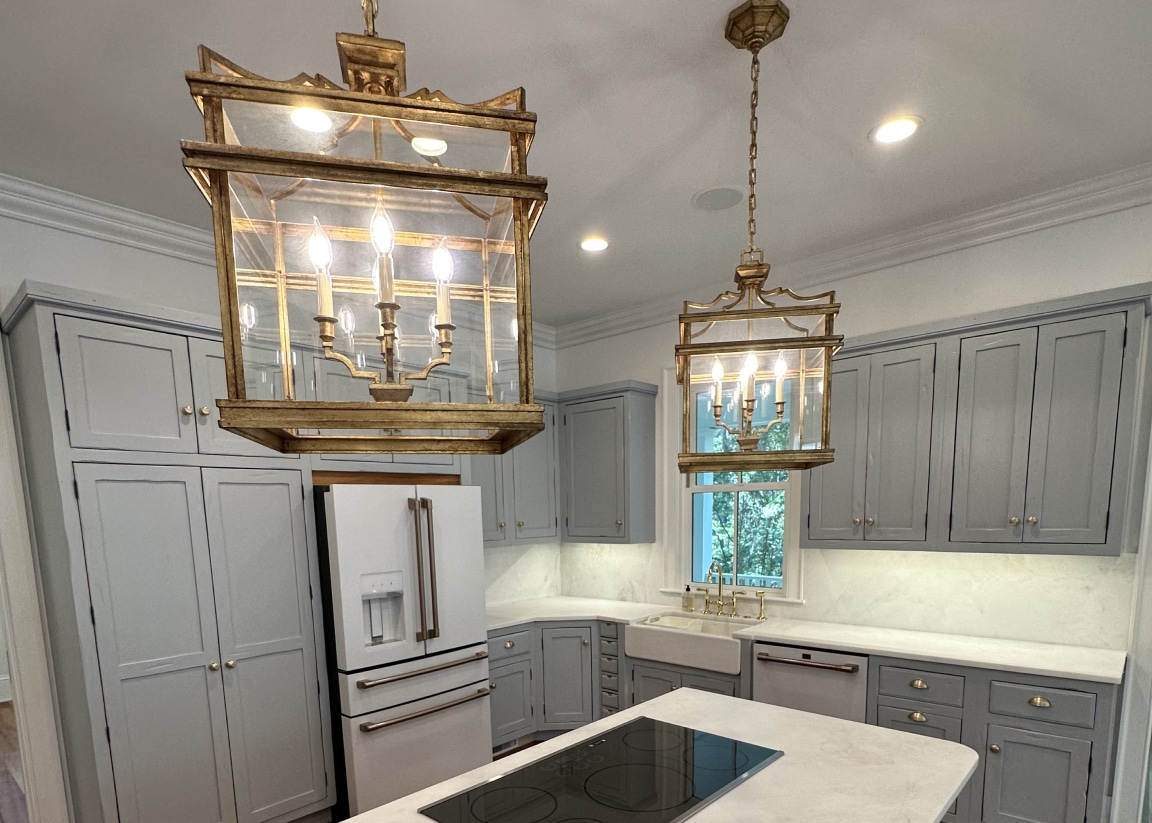
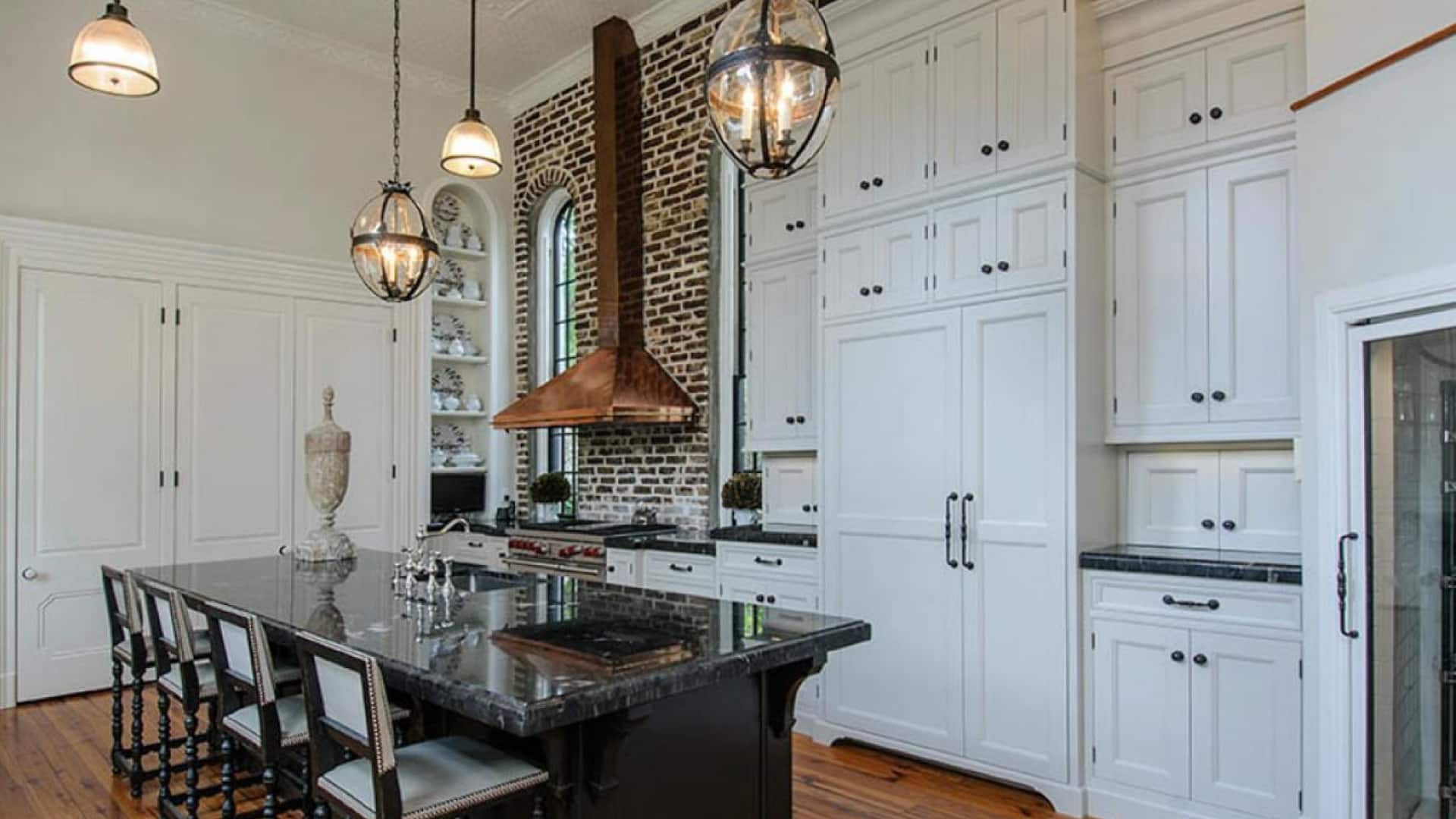
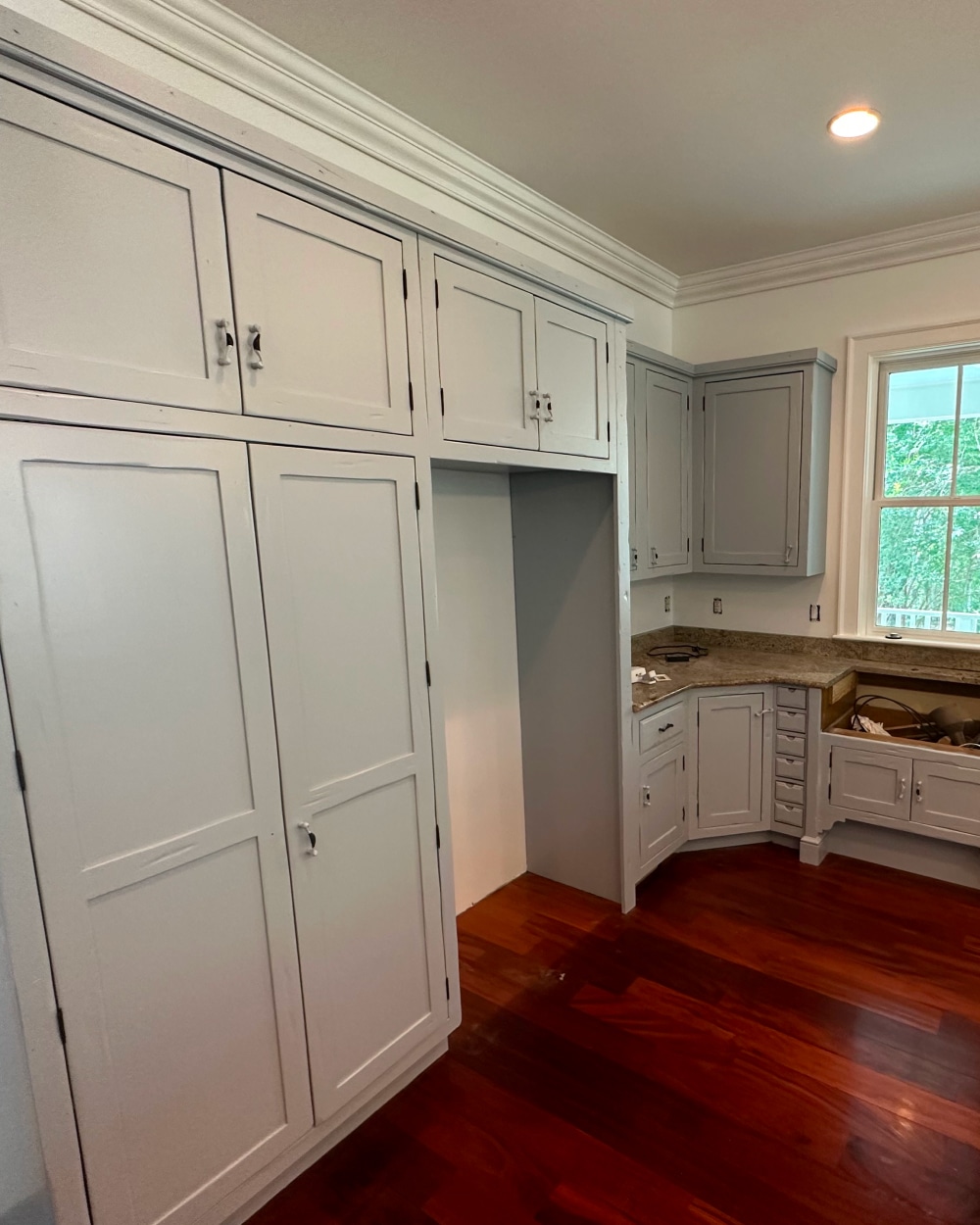
Recent Cabinet Refinishing Projects
Book Your Cabinet Refinishing Estimate
Elliott walks your kitchen, checks the substrate, tests for lead if your home is pre-1978, and provides a written estimate on the spot. Financing available on qualifying projects — ask at your estimate.
Cabinet Refinishing FAQ
How much does it cost to paint kitchen cabinets in Charleston?
Cabinet refinishing costs a fraction of full replacement — the exact number depends on the size of the kitchen, the substrate, and the condition of the existing cabinets.
A standard 30–40 linear-foot kitchen with solid-wood face frames and doors falls into one range, while a larger kitchen with laminate boxes that require a shellac-based primer falls into another. We provide a written estimate after a 30-minute on-site consultation.
How long does cabinet refinishing take?
Most projects take 7–10 days from door removal to final rehang.
Prep and priming typically take 1–2 days. Spray application and dry time between coats take 2–3 days. Cure time before rehang is a minimum of 7 days and 10 days during Charleston summer humidity.
Is painting cabinets cheaper than replacing them?
Yes — refinishing costs a fraction of replacement.
Replacement involves demolition, disposal, new cabinet boxes, installation, and often new countertops and backsplash work. Refinishing keeps your existing boxes and layout while giving the cabinets a factory-smooth new finish.
What kind of paint do you use on kitchen cabinets?
We use Benjamin Moore Advance or Sherwin-Williams Emerald Urethane Trim Enamel — both are engineered specifically for cabinets and trim.
Standard wall paint is not designed for the heat, humidity, and constant contact that kitchen cabinets experience. Primer selection depends on the substrate, with Zinsser BIN shellac-based primer used on laminate, thermofoil, and factory-lacquered surfaces.
How long do painted cabinets last?
A properly refinished cabinet can last 10–15 years before it needs significant touch-up work.
Our 2-year workmanship warranty covers peeling, blistering, and chipping caused by defective workmanship.
Can you paint laminate, MDF, or thermofoil cabinets?
Yes — with the right primer.
Laminate, thermofoil, and factory-lacquered cabinets require a shellac-based primer such as Zinsser BIN because standard bonding primers do not reliably grip those slick surfaces.Yes — with the right primer.
Laminate, thermofoil, and factory-lacquered cabinets require a shellac-based primer such as Zinsser BIN because standard bonding primers do not reliably grip those slick surfaces.
Do I need lead paint testing for cabinets in a pre-1978 Charleston home?
If your home was built before 1978, there is a possibility that older layers of paint may contain lead, even if newer coatings applied over the years do not.
When painted surfaces are scraped, sanded, or otherwise disturbed during a repaint, homeowners should ask their contractor how lead-safe work practices will be handled and what precautions will be taken to contain dust and debris.