

Charleston homeowners rarely think about exterior paint until something looks off: a chalky residue on the siding, uneven fading on one wall, or a paint job that failed years earlier than expected. The answer depends on more than what’s printed on the can. Siding material, sun exposure, proximity to open water, and how well the surface was prepped all shape how long paint actually holds up here. This guide breaks down what to expect by material, what’s different about the coastal climate, and how to tell when a wash will do versus when it’s time for a full repaint.
The Quick Answer: How Long Exterior Paint Typically Lasts

How long does exterior paint last? Homeowners get a wide range of answers, and the honest answer is that it depends. Nationally, quality exterior paint typically lasts 5 to 10 years.
Charleston’s coastal climate narrows that range. Homes here typically go 5 to 7 years between repaints, and in tougher spots, closer to the water, on unshaded south- or west-facing walls, or with older, poorly prepped surfaces, that can drop to 3 to 5 years.
What Affects How Long Exterior Paint Lasts in Charleston?

Paint doesn’t fail on a fixed schedule. Three variables decide whether a Charleston home gets 3 years out of a paint job or 10: surface prep before the first coat, how much direct sun different walls take, and how much salt and humidity the coating has to withstand.
Does Surface Prep Really Change the Timeline?
Prep is the single leading cause of premature peeling, and the gap it creates is significant. Paint applied over unsanded, damp, or unprimed wood can fail well ahead of schedule, while the same paint applied over properly prepped wood reaches its expected service life. Purdue University’s research on paint failure attributes most premature coating failures to inadequate surface preparation rather than the paint itself.
Wade Paint Co. treats prep as the most important part of the job: rot repair, sanding down to sound wood, moisture remediation where water has been getting in, and full priming before any topcoat goes on. Skipping any of those steps is the most common reason paint fails years ahead of schedule.
How Does Charleston’s Humidity and Salt Air
Speed Up Wear?
Charleston sits in a humid subtropical climate with high humidity year-round, according to Charleston’s official climate normals from the National Weather Service. That persistent moisture keeps exterior surfaces damp longer after rain and overnight dew, giving coatings less time to fully cure between wet spells.
Salt air adds a second layer of stress. Salt is hygroscopic, meaning it pulls moisture from the surrounding air, and that constant moisture cycling speeds up oxidation and breaks the coating down faster than it would inland. The EPA’s guidance on how humidity encourages mold growth explains why damp conditions support mildew generally, and that same moisture makes Charleston exteriors work harder than paint in a drier climate.
Does Sun Exposure and Siding Direction Matter?
Yes. The difference between walls on the same house can be significant. South- and west-facing walls take the most direct UV exposure through the afternoon, breaking down paint resins faster than on shaded north- or east-facing walls. One side of a Charleston home often needs a repaint years before the others.
Darker colors absorb more heat and expand and contract more with daily temperature swings, which stresses the coating over time. Wade Paint Co. offers a free color consultation for sun orientation, helping homeowners choose colors and finishes that account for which walls take the most sun before the crew ever picks up a brush.
How Long Does Exterior Paint Last by Siding Material?

These ranges assume typical Charleston exposure. Homes closer to the marsh, tidal creeks, or open water should expect the shorter end of each range.
Wood Siding: 5 to 7 Years With Proper Prep
Properly prepped and primed wood siding typically holds up for 5 to 7 years in Charleston before it needs repainting. Wood is naturally more prone to moisture movement than manufactured siding, so the outcome depends heavily on prep quality: unsanded or unprimed wood can fail well short of that range, while the same wood done right reaches it.
Fiber Cement Siding: 8 to 12 Years
Fiber cement, sold under brands like HardiePlank, holds paint longer than almost any other siding material used here, typically 8 to 12 years. It doesn’t expand and contract with humidity the way wood does, and it resists moisture absorption, giving the paint film a more stable surface to bond to. That stability is why fiber cement outlasts wood and vinyl in coastal conditions.
Stucco and Masonry: 6 to 10 Years
Stucco and masonry surfaces typically hold paint for 6 to 10 years in Charleston. Both are porous, which helps the paint bond well initially, but that same porosity makes them prone to hairline cracking as the substrate expands and contracts with moisture. Sealing small cracks early keeps water from getting behind the coating and shortening its life.
Vinyl Siding: 5 to 10 Years, and Why Painting It Can Void Your Warranty
Vinyl siding itself typically lasts 5 to 10 years between paint jobs when it’s painted at all, but there’s a warranty detail worth knowing beforehand. Most vinyl manufacturers, including CertainTeed, Ply Gem, and Alside, void the product warranty once the vinyl is painted, a manufacturer policy that applies regardless of who does the work or how well.
Homeowners considering painting older or faded vinyl should check their manufacturer’s warranty terms first, since replacing the siding may be a better option in some cases. When painting vinyl is the right call, the surface needs specific prep and paint types suited to how vinyl expands and contracts with heat. Our exterior painting process accounts for that difference instead of treating vinyl the same as wood or fiber cement.
Trim, Doors and Shutters in Salt Air: 3 to 6 Years
Trim, doors, and shutters wear faster than the siding around them, typically needing repainting every 3 to 6 years in Charleston’s salt air. These ranges reflect general professional consensus among coastal painters rather than a stat from a national testing body. Trim sits closer to ground-level moisture and gets more handling and weather exposure than wall siding, and shutters catch wind-driven salt spray directly. Watching these smaller elements between full repaints helps catch failure early, before it spreads to surrounding siding.
Marsh-Side vs. Inland: Does Your Charleston Neighborhood Change
the Timeline?

Charleston isn’t one climate. A home on Sullivan’s Island or the Isle of Palms sits directly exposed to open water and near-constant salt spray, while a home in West Ashley sits several miles inland, shielded by tree cover and distance from the harshest marine air.
Homes with direct marsh or open-water exposure, including waterfront properties on Sullivan’s Island, the Isle of Palms, and parts of James Island along the tidal creeks, often need repainting 2 to 3 years sooner on their most exposed elevation than a comparable home set back from the water. The wall facing the marsh or the ocean takes the brunt of the salt air and wind, while the opposite side of the same house can hold up noticeably longer.
Inland neighborhoods don’t escape Charleston’s humidity, but they avoid the constant salt exposure that accelerates wear on the coast. Wade Paint Co. handles Sullivan’s Island painting, Isle of Palms exterior painting, and James Island painting services for properties along the marsh, along with West Ashley’s inland painting projects, adjusting prep and product choice to match how exposed each property actually is.
Signs It’s Time to Repaint (Not Just Clean)

Not every faded or dingy wall means it’s time for a full repaint. Some issues clean up with a wash; others signal the coating itself is failing.
1. Chalking: A Powdery Residue on Your Hands
Run a hand across the siding. A fine, powdery residue means chalking, a normal sign of paint aging as its binders break down under UV exposure. Light chalking often just means a wash, and possibly a fresh coat, is due soon. Heavy chalking that keeps returning after cleaning usually means the paint has reached the end of its service life.
2. Hairline Cracking Near Seams and Corners
Fine cracks at seams, corners, and butt joints usually show up before more visible peeling does, forming as the paint film loses flexibility with age and the substrate keeps expanding and contracting with temperature and humidity. Left alone, these cracks let moisture behind the coating, speeding up failure in the areas already under the most stress.
3. Caulk Gaps and Separation Around Trim
Caulk has a shorter lifespan than paint, and once it shrinks, cracks, or pulls away from trim and window edges, water has a direct path behind the siding. Gaps around trim are often the first visible sign a home needs attention, even when the paint on the wall still looks fine. Recaulking promptly can buy time before a full repaint is needed.
4. Mildew Streaking vs. Simple Surface Dirt
Dark streaking, especially on north-facing walls or under eaves, is often mildew rather than dirt. Dirt tends to wipe off dry or with light rain; mildew leaves a stubborn, blotchy stain that regrows after a light rinse. Mildew staining usually means the paint underneath is fine, and a wash resolves it, no repaint required.
How to Get 8 to 12 Years out of Your Next Paint Job

Reaching the long end of these ranges comes down to a handful of controllable factors.
1. Use 100 Percent Acrylic Paint With a Mildewcide
Not all exterior paint is built for Charleston’s climate. Wade Paint Co. uses 100 percent acrylic paint lines with mildewcide additives, which resist the mildew growth common in humid, shaded areas. Sherwin-Williams’ Duration line is built on mildew-resistant coating technology, and Benjamin Moore’s Element Guard is engineered for humidity and wind-driven rain, both holding up better in Lowcountry conditions than standard exterior paints.
2. Apply Two Full Coats, Not One
A single coat, even of premium paint, rarely reaches the film thickness needed for full protection. Two full coats build the coverage and thickness that block UV and moisture consistently across the surface, rather than leaving thin spots where the old color or bare substrate shows through and fails first.
3. Seal Penetrations Before You Paint
Fasteners, trim joints, vents, and other penetrations are common entry points for water, and paint alone won’t seal a gap that’s already open. Sealing these areas before painting keeps moisture from getting behind the new coating at its weakest points, often where premature failure starts even on an otherwise well-painted wall.
4. Schedule an Annual Soft Wash
Removing salt residue, pollen, and mildew buildup once a year keeps those contaminants from working into the paint film between full repaints. An annual soft wash is a small maintenance step that protects the investment in a proper paint job. See our recent repaint projects for an idea of how a well-maintained exterior holds up over time.
Wade Paint Co. backs every exterior project with a 2-year workmanship warranty, covering peeling, blistering, or chipping caused by defective workmanship.
Ready for Paint That Lasts in Charleston’s Climate? Get Your Free Estimate
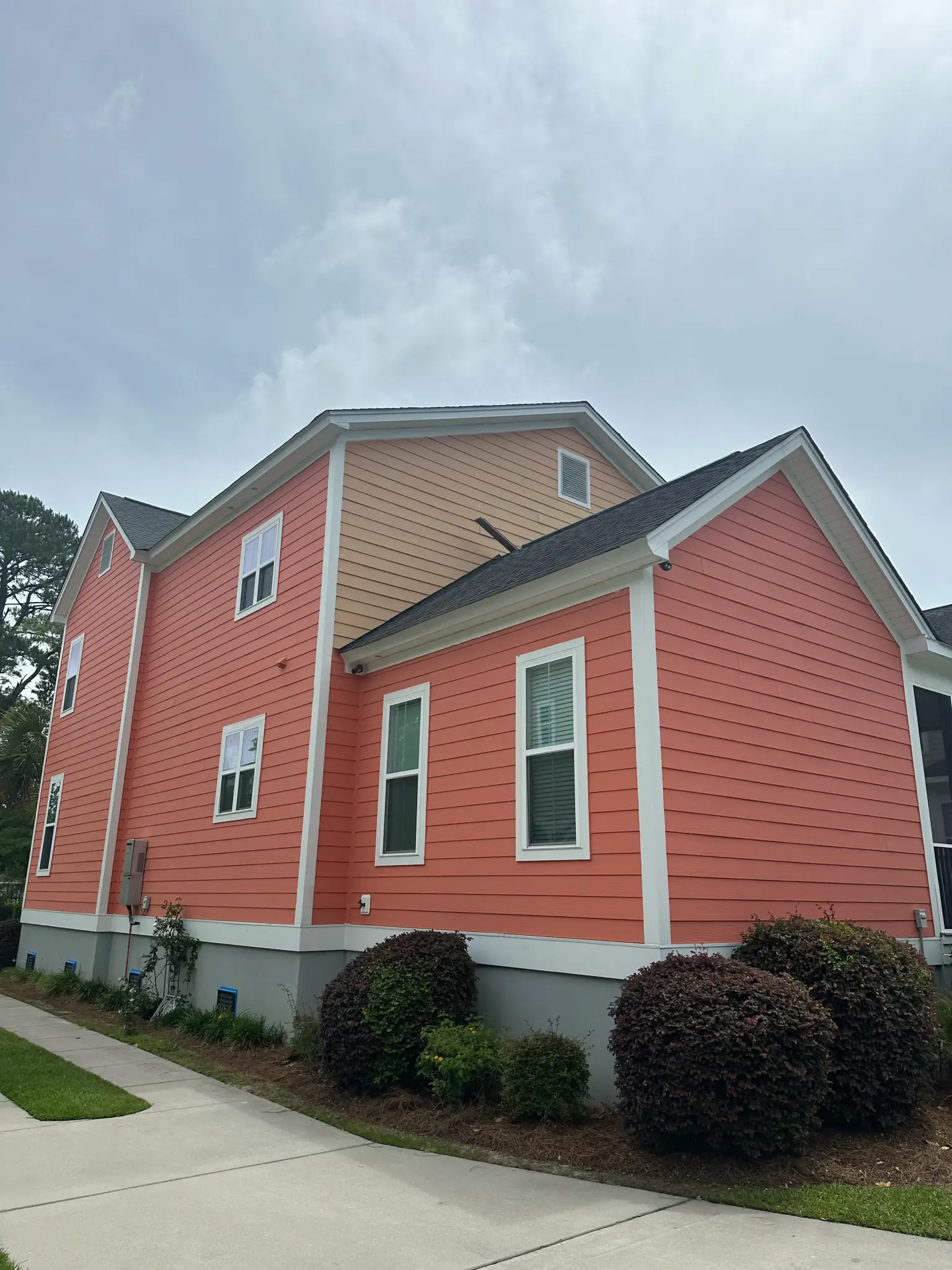
Heat, humidity, and salt air make a tough combination for exterior paint in the Lowcountry, and cutting corners on prep is the fastest way to end up repainting years ahead of schedule. Wade Paint Co. built its process around that reality: meticulous surface prep, climate-timed application, and premium Sherwin-Williams and Benjamin Moore paint lines suited to the coast. Owner Elliott Hall personally oversees prep and application on every job. Get your free Charleston painting estimate and find out what a paint job built for this climate actually looks like. If you want to know more about exterior painting guides, head over to this page.
Frequently Asked Questions
Can I pressure wash chalky or faded paint instead of repainting?
Light chalking or surface dirt often responds well to a soft wash, which can extend the time before a repaint is needed. Heavy chalking, cracking, or peeling won't be fixed by washing, since those signal the coating has already failed rather than just gotten dirty.
Does Charleston's humidity really shorten paint life that much?
Yes. Charleston's humidity and salt air combine to speed up oxidation and coating breakdown, which is why local paint jobs often land toward the shorter end of national averages compared to drier regions inland.
Should I avoid painting my vinyl siding?
Not necessarily, but check the manufacturer's warranty first, since CertainTeed, Ply Gem, Alside, and most other vinyl manufacturers void it once the siding is painted. Replacement is sometimes the better option, but painting can still make sense depending on the situation.
What does Wade Paint Co.'s workmanship warranty actually cover?
Wade Paint Co.'s 2-year limited workmanship warranty covers peeling, blistering, and chipping caused by defective workmanship from the completion date. It doesn't cover horizontal surfaces, manufacturer defects, weather-related damage, substrate moisture issues that existed before the project, and other standard exclusions.
Does a lighter paint color last longer in direct sun?
Generally, yes. Lighter colors absorb less heat than dark ones, meaning less expansion and contraction across daily temperature swings. On Charleston's south- and west-facing walls, a lighter color can help a paint job land closer to the long end of its expected range.

